



embodied, embedded – Beat Huber listening to the sound of the flowing creek 1961
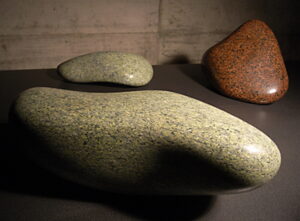
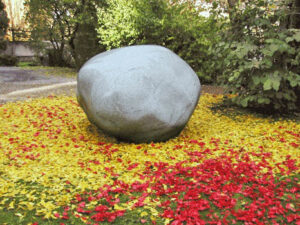
STONE – an allegory on the theme of the compulsion to conform
Stones fallen out of rocks on the surface of the earth – rounded weightlessly in the currents of water, ice, sun and wind – a pebble exists like a human being on the living surface of the earth. Rolling stones … rubble and boulders in the mass, but as a single pebble as unique as every single person.
We humans are a part of our phenomenology ourselves, but we are still humans: someone special. And yet we are also part of the oxidizing patina on the surface of the earth.
During my years of working as a stonemason, I deepened my artistic relationship with the natural material and took small steps into the perfect, sublime world of rubble.
By refraining from using forms in my sculptures that are foreign to eroded crystalline stone, I adopt a strictly materialistic perspective. The form inherent in the material reveals itself to me as I work on it and perfect it according to my own vision.
The relationship with nature reduced to profit, together with the recognition of the biological conditionality of our existence, define the philosophy of materialism.
It is my opinion that art reveals the inner thoughts of an individual and speaks to other individuals. Accordingly, I believe that the formats of my sculptures exist within an economic context in society, where work ultimately serves to improve the lives of all people. For this reason, my artworks should be affordable, particularly for working people.

Background
In his novel Island (1962), Aldous Huxley (1894–1963) contrasts two forms of materialism: our superficial fixation on possessions is described as “abstract materialism”. “Concrete materialism” is morally valued more highly than this abstract materialism of possession and is presented as an important component of human creativity:
“Concrete materialism, on the other hand, requires full mindfulness in everything one does and one experiences. … In concrete materialism, one must be fully aware of the individual materials that pass through one’s hands, as well as of the dexterity with which one goes about one’s work and as well as of the people with whom one works.” … And further: “concrete materialism is quite simply the raw material of a fulfilled human life.”
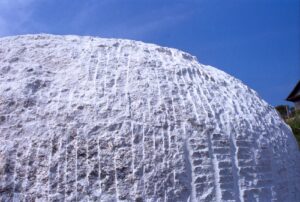
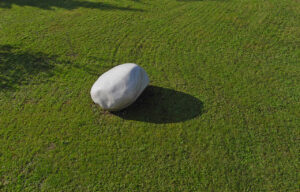
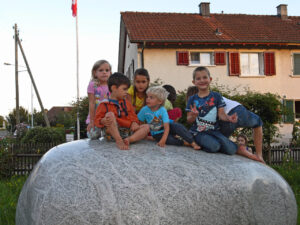
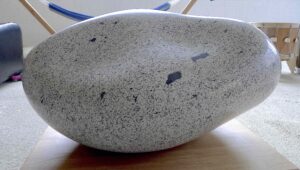
From birth to death, every single person is compelled to constantly conform to the society in which they live in order to be able to live within it. The narrative of my artistic experiment STONE is about an act of taming wilderness. The form that is naturally inherent in every stone becomes refined, allowing the rough stone from nature to find its way into our homes. Furthermore, in order for the stone I have picked up to become an artefact, it is isolated from its biological context by the working process, whereby the living surface of the earth that also exists on it is mechanically separated from it. Immediately after the final polish, it has become biologically isolated, sterile matter on the living surface of the earth. Like anything new, the sculpture carved from rough stone is a FOREIGN BODY; it belongs neither to nature nor is it in line with tradition. On the other hand, linguistically this sculptures by their form and material are firmly defined by the term “stone.”
I’m in for a surprise.: the more strictly I observe what happens while I am working, the stranger such a stone appears in the context of contemporary art.
Worth reading: the book “The Lonely Crowd” 1950, by David Riesman e.a. Google AI on the compulsion to conform in “The Lonely Crowd” : “The authors view the “compulsion to conform” as the conforming of the individual to the needs of a consumer-oriented and bureaucratic society…” – One can even listen to the book for free: youtube.com/watch part 1 , youtube.com/watch part 2